ARIJIT MUKHOPADHYAY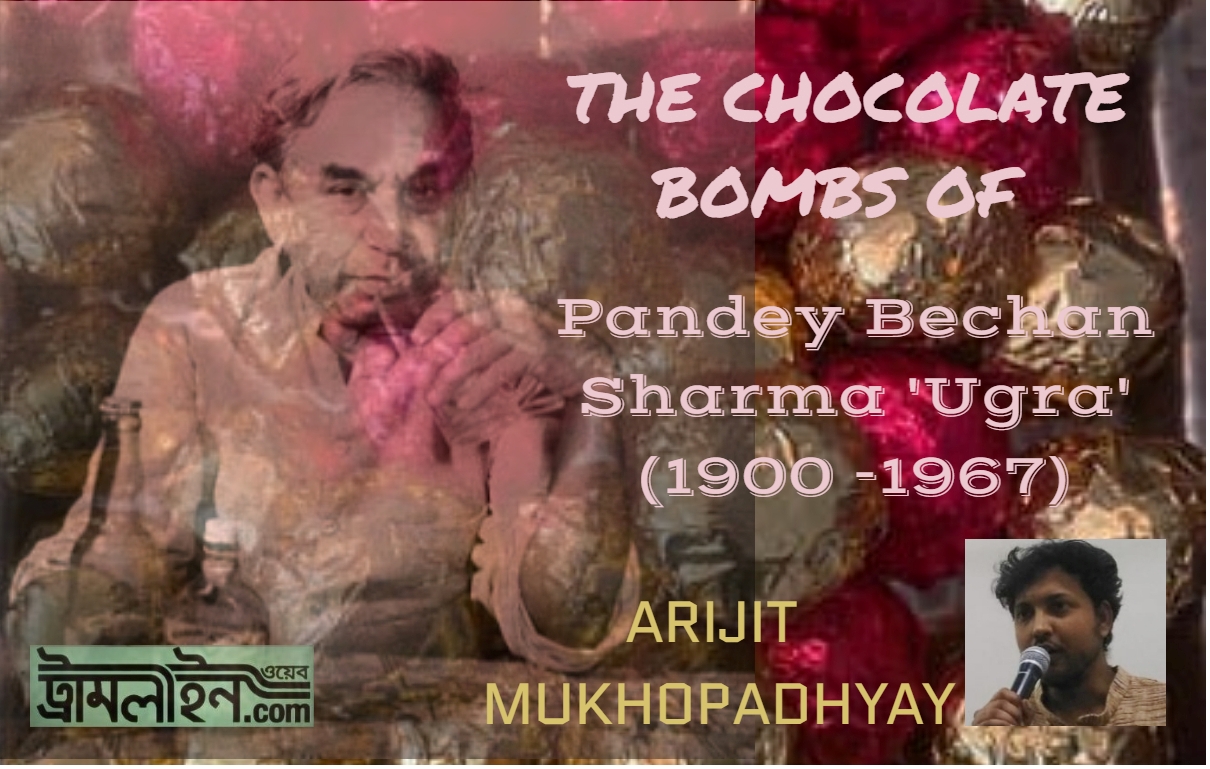
‘My bee, the dark one, is a thief.
The beautiful one stole my heart with a sidelong glance.’
– A famous verse by Surdas (in Brajbhasha). Here ‘the dark one’ is Shri Krishna.

‘As I bowed down to pay my final homage to his lifeless body, now resting on the funeral pyre, I was suddenly overwhelmed with the realization that he will never speak again. It felt like he was only sleeping. In a moment he will awaken, sit up and start delivering a speech in his characteristic style, using his uncouth and extreme (ugra) language. Ugra ji possessed an impeccable personality. He never became one with the crowd. The depths of his psyche were home to some central themes which troubled him forever and made him impatient. How would he have become Ugra (extreme) if he only followed the league?’
- Renowned Hindi writer Vishnu Prabhakar (recounting his feelings just a day after the death of Ugra in 1967)
The 1910s and 1920s marked the onset of widespread nationalist upsurge in India: civil disobedience, protests and unrest on one hand and extremism and bombings on the other hand. Militant nationalism in places like Bengal, Punjab and Maharashtra aimed to not only uproot British rule but also establish a new hyper-masculine racial identity. Bombs were now being used to intimidate the British. The other form of nationalism was preached and propagated by Gandhi, which discouraged the use of bombs and violence, but still managed to intimidate the British government. In the wake of this nationalist fervour, Indian reformers and litterateurs called for large-scale purification of our medieval and pre-colonial literary texts. The Hindus managed to denounce and suppress much erotic medieval poetry, especially those in Hindi, Sanskrit and Bengali. Muslim reformers superficially heterosexualized the ghazal and cornered much of Urdu Rekhti poetry. It was during these times that the Hindi literary landscape was shaken by the emergence of Pandey Bechan Sharma ‘Ugra’ and his stories depicting male-male desire. Much like attractively coloured chocolate bombs, his fiction exploded loudly, causing discomfort among the champions of morality and purity. Although inherited from the British, this essentially Victorian sense of morality was well entrenched in the minds of the Indian nationalists by that time.
‘Chaaklet’ (‘Chocolate’) was the first of Ugra’s notorious bombs which exploded on the Indian literary scene on the 31st of May 1924. It tells the story of Babu Dinkar Prasad, B.A., and his obsession for a young boy named Ramesh. The story also introduces the term ‘chaaklet’ to Hindi readers, presumably for the first time – a coinage which, as the character Manohar reveals to the narrator, was used mostly in the United Provinces (what is now Uttar Pradesh) to refer to ‘innocent, tender and beautiful boys of our country’ whom certain educated men in our society make ‘bad-charactered’.
Indian literature was introduced to this coinage (and the connotation) through this story, although if Manohar is to be believed, terms like ‘chaaklet’ and ‘pocket book’ were already very common among Hindi and Urdu-speaking people in central India, besides other names which ‘cannot be written in civilized language’.
The story became a rage. Soon, the Indian literary scene would be drenched in the obscene blue-black ink of Ugra, just like Babu Dinkar Prasad who gets ‘drenched from head to foot’ by ink spilled by his object of desire (Ramesh):
‘Seeing him pounce, Ramesh pretended to throw the ink-bottle at him, merely with the intention of frightening him. But look at this!! The bottle remained in his hand but the cork came off. Dinkar Babu was soaked in ink!! As if he had played Holi, he was drenched from head to foot.
Dinkar was overcome with humiliation, anger, shame and desire all at once. Ramesh stood stunned by this sudden turn of events. Dinkar caught hold of him and began to embrace and kiss him: ‘Angry with me? With me? Darling, darling!’
Just then, I entered the room. Hearing my step, Dinkar released Ramesh. Ramesh’s face was also black from contact with Dinkar’s ink-stained face! ’ (translation: Ruth Vanita)
THE REACTIONS: Who’s Afraid of Chocolate Bombs?

The immediate impact of this short story was as anarchic as it was revealing. It had sent the orthodox puritans scampering for some good old homophobic shelter. The sales of ‘Matvala’, the newspaper published twice every month in Calcutta, and which was already very sought after among Hindi-speaking readers, increased meteorically after the publication of ‘Chocolate’. As Ugra himself would later admit, it threw a pall of silence over other newspapers, aroused a storm among readers and resulted in the editor of ‘Matvala’ receiving ‘sheafs and sheafs’ of letters, both of praise and condemnation. Ugra was actively associated with this paper. There were reports of people waiting in endless queues outside bookstores in Calcutta, waiting to buy the first edition of ‘Chocolate’ when it came out in book form in 1927 (along with seven more stories). This was three years after his friends had advised him not to write on male homosexuality any more, for it was becoming ‘scandalous’. The only thing this ‘advice’ did was to incite him further, and he ended up writing more stories and published eight stories in all in the collection titled ‘Chocolate’.

In a critical assessment of Ugra’s stories titled ‘Chocolate and Paalat’ (published in ‘Matvala’ a few months later), Ramnath Lal (pen name ‘Suman’) wrote that boy-worship had indeed almost ‘displaced the worship of the gods’ among Indian men. He went on to claim that this was the biggest problem facing India, since it pervaded all castes, communities and religions. He warned his readers that it was easy to get attracted to homosexuality reading Ugra’s stories but that there was ‘no way to control reader responses’.
It is interesting to note that the settings of Ugra’s stories hardly have a female character, if at all. Ugra’s characters are mostly young men (the lovers), teenage boys (the beloveds) and some other male characters (friends) and the narrator himself. However as John Boswell points out, the terms ‘boy’ (‘baalak’, ‘laundaa’ or ‘ladkaa’) or ‘girl’ function as diminutive endearments in erotic contexts, often unrelated to age, as in ‘boyfriend’ or ‘girlfriend’. We have to understand that age was not a factor in those days as much as it is today in urban middle-class societies – women used to get married off at ten or twelve. In the story ‘In Prison’ for instance, Ugra shows prisoners fighting over handsome men of any age.
Although many attributed Ugra’s growing popularity to his controversial image, it cannot be denied that his stories depicting male-male desire had successfully subverted the fragile hetero-normative moral codes prevalent in the literary landscape. What worried the litterateurs, reformers and critics the most was the fact that these stories were in Hindi, a language which had almost become the official language of the nationalist movement. It is believed that at one stage, Ugra had become more popular than Munshi Premchand.
One of the most vocal critics who launched a full-blown attack on Ugra was the editor of the nationalist literary journal ‘Vishal Bharat’, Banarasidass Chaturvedi. He likened Ugra’s stories to ‘Ghaslet’ (literally meaning kerosene oil, with the derivative meaning being inferior literature). In 1929, he called for public resolutions to be passed against writers like Ugra, for libraries to boycott their books and for the public to vehemently oppose booksellers who sold their books. Interestingly, the movement against ‘Ghasleti’ literature was built on the argument that these ‘indecent’ and ‘filthy’ stories inflamed rather than extinguished sexual desire. The boycott of these books was supposed to invoke the spirit of civil disobedience, while actually ended up misusing it. This kind of misuse of civil obedience was already predicted by none other than Rabindranath Tagore.

It is true that Ugra himself positioned himself as a nationalist (indeed, he was even jailed for editing an anti-British issue of the paper ‘Swadesh’) and he said his stories are like ‘undiluted quinine’, written to caution his readers against moral misconduct. However, his stories are rife with the vivid depiction of the same form of sexual desire which he claimed he (like the characters in his stories) denounced. For this reason, according to Ruth Vanita (eminent scholar and author), these stories ‘nevertheless do give a picture, however distorted, of urban Indian homosexual and bisexual men’s social life and language in the early twentieth century, and even of their self-view and self-defence. And one of Ugra’s novels…depicts an intensely romantic male-male friendship.’ Ugra himself, in his preface to the collection ‘Chocolate’, writes that the settings in his stories are not at all unusual but representative of the wider society.

Referring to the titillating title ‘Chocolate’, Chandragupt Vidyalankar pointed out that if Ugra really wanted to cure the ‘illness’, he would have named his story ‘Poison’ instead. Why name a story after something which is irresistibly attractive and even more popular than traditional Indian sweets? Why make literature out of such an ‘obscene’ form of sexual desire and name it after something which was not ‘Indian’? Critics in recent years have observed that Ugra was completely different from his contemporaries in this matter. He has used the term sarvabhogi (taking pleasure in or consuming everything) very consciously in some of his writings. The term ‘sarvabhogi’ not only hints at homosexuality and bisexuality, but also rejects the nationalist movement’s obsession with boycotting foreign goods – an obsession which was criticized by Rabindranath Tagore. Indeed, Ugra claims in his memoir ‘Apni Khabar’ (1960), ‘As long as I am unformed, any form and all forms are in me’.
Most critics and litterateurs, including Munshi Premchand, cast a doubt over Ugra’s intentions, stating that focusing on same-sex desires and hedonistic pleasures in literature will never cure the ‘illness’ but rather result in spreading it. While intending to highlight (albeit erroneously) the ‘western origins’ of male-male desire, Vidyalankar pointed out the term ‘chocolate’ normalizes that desire because chocolate is universally popular.
THE FIRST RULE OF HOMOPHOBIA
By the 1920s, with regard to matters related to ‘unnatural’ sexual indulgence, silence was well-established as the impulsive attitude. If Tyler Durden were the face of the nationalist movement in India, he would have probably spelled it out loud and clear: ‘The first rule of homophobia is, do not talk about homophobia.’ Ugra admits in his foreword to ‘Chocolate’ that his friends always warned him about the consequences. People had started calling him ’frivolous’, ‘chocolate’, ‘laundebaaz’ and what not. He was apparently told: “When the whole society wants to keep quiet about it, why are you playing with fire?”

We get the impression that Ugra knew what he was doing, sneaking in seductive chocolate boxes wrapped in the garb of cautionary tales. Several of his stories are written in first-person narrative. In most (if not all) of his stories, the narrator is omniscient. He is almost always present at the site of a scandalous incident, that too after having a presentiment. He is vocal about the ‘base’ and ‘loathsome’ propensity of some friend or acquaintance of his for laundebaazi. One gets the feeling that Ugra’s narrator is a curious person. He is always present at soirees where the man who he so openly despises (usually the host of the party) sets about reciting couplets and poems in praise of some young male beauty he is waiting for. He silently peeks through doors or overhears from outside the door as a whole incident unfolds right before him. He does not intervene until much has already taken place. And we, the readers, get a detailed account of everything that just took place. Most of these stories end abruptly, on an unpleasant note, but Ugra does not resort to melodrama or the various tropes of tragedy to describe the misfortune befalling the ‘victim’. Instead we get a clearer picture of the narrator himself, who seems to feel vindicated by the ‘moral’ downfall of some young boy and finally expresses his own moral superiority. For instance, right at the end of his story ‘Paalat’ (‘Kept Boy’), the narrator says:
‘Finally, that rogue was forced to run off to Calcutta to survive.’
The irony does not escape the reader. Calcutta in those days was the quintessential melting pot, a composite cosmopolitan city where all kinds of people took refuge and lived with dignity. This was the city of Battala literature. This was the city of Tagore, a towering figure who had critiqued Bankim Chandra Chatterjee’s clarion call to renounce Vrindavan’s polygamous Krishna. This was the city where a Hindi paper like ‘Matvala’ (meaning ‘intoxication’) could be brought out, with which writers like Ugra and the great Nirala (Suryakant Tripathi) were associated.

It must be noted that Nirala, a great admirer of Tagore, was perhaps the only Hindi litterateur of repute who supported Ugra’s fiction in relatively non-homophobic terms. He severely criticized his opponents (mainly Chaturvedi) who he said were ‘hacks devoid of talent, driven by personal and political antagonisms’. While arguing in favour of artistic freedom, Nirala also rallied against the dominance of ideology, something which antagonized a considerable section of the up-and-coming Marxist litterateurs.

Citing examples of Byron and Oscar Wilde, Nirala, in a 1934 essay, observed that personal hatred for some writers prejudices critics of their writings. Incidentally, Wilde was among Ugra’s favourite writers, so much so that he likened him to Shri Krishna, placing him above more ‘puritanical’ writers like George Bernard Shaw. In his novel ‘Phagun ke Din Char‘, Ugra comments on Wilde’s life, his works and his fate. Wilde was known for his affairs with both men and women, but unfortunately became more famous after the widely documented cross-examination in 1895 by a prosecutor named Edward Carson who skillfully ‘proved’ that Wilde liked kissing good-looking young men (https://www.famous-trials.com/wilde/327-home).
Ugra wrote that if Shaw was the sage of art, Wilde was its Krishna. This he wrote at a time when the monogamous Rama was being exalted as the ideal in our country – someone who never indulged in any kind of adultery or more specifically polygamy which was practised by the Krishna of Braj. Ugra, therefore, was making a very bold statement.
THE PRESENT TENSE: A TENSE PRESENT?
Some years back, a veteran Bengali journalist (known to be a Communist Party sympathizer who was curiously turning right-wards back then) was seen sitting up with an almighty jerk after receiving what was for him a grotesque, shocking news! (I happened to be there by chance.) Cristiano Ronaldo, the greatest ever footballer according to him, is gay! While looking for news material about him on the internet, he had stumbled upon reports claiming that Ronaldo often visited his ‘boyfriend’, a Moroccan kick-boxer and even went on vacations – just the two of them.
In the minutes that followed, he went on expressing his disbelief and despair, exclaiming, ‘Why did he need to check into a hotel saying they’re a married couple? He could’ve said they’re friends…ehh!’
One of his employers tried to console him by saying, ‘Dada, many sportsmen, especially professional club-footballers hang out with men more often than they do with women. Maybe they are close friends and maybe they were only fooling around with the receptionist…’
Our Dada was crestfallen. I pounced on the occasion, if only to reassure him Ronaldo was not the only culprit.
‘Dada, even Maradona had kissed—’ I wasn’t allowed to finish.
‘Stop, stop, please,’ he almost wailed in disgust. ‘Such big players…and, isshhh, look at the photos…isshhh…ehh!’
The disappointment was visible on the face of the veteran journalist. It was as though one of his trusted allies had betrayed him and committed a historic blunder – the sort of blunder that heterosexuals (and Communists) like him cannot afford to accept: he had claimed to be a practising homosexual in public domain. The one who had tried to console him was now standing behind his boss and trying his best to conceal his laughter. While it is now a well-publicized fact that Ronaldo is most probably interested in both women and men, it is strange how we, as mere consumers of entertainment, so desperately need to live in denial of certain truths or possibilities only because they do not align with our preferences or prejudices. For instance, in this case, Ronaldo, seen as the quintessential modern male – muscular, swift, full of machismo and swagger – is a template for upholding the desirable virtues of the ‘macho male’ archetype, whose ultimate (and only) sexual fantasy would be intercourse with (and most of it, invading) a woman. Our dada was maybe shocked because he was obsessed with such an idea – an idea which assumes quite obstinately that any man who is a part of a regimented set-up (army, boarding school, hostels, factories, etc.) or is involved in the disciplinary routines of high-profile professional sports is necessarily a ‘normal’ heterosexual man ultimately aiming for a settled life with one woman for the entire life if possible, or at least with women, no matter the number.

INSTITUTIONALIZED HOMOPHOBIA: A WESTERN IMPORT?
Following the aftermath of the Sepoy Mutiny of 1857, there was a well thought-out assault by British administrators and missionaries on Indian sexual practices and mores. The subject was relatively untouched by the colonizers till then or at best mentioned casually. By assuming a moral high point (unsurprisingly) they now condemned sexual mores in India, calling them promiscuous, and idolatrous. It was as though a report card had been handed over to them after the examination, the remarks being something like: ‘Physically weak, effeminate, sexually dubious, you are a spoiled race. Do as the Lords do, if you want to be a man’. Our learned men took it to heart perhaps. There was little objection when, in1861, Lord Macaulay drafted Section 377 into the Indian Penal Code (IPC) as part of a drive to control the native Indian’s view of sexuality. They laid out moral codes which could be used to persecute their Indian slaves indulging in ‘unnatural sexual intercourse’, and also to send a strong message back home. The message was that the British Empire is doing to its colonies what it had been doing in its own backyard for quite some time: in short, equating homosexuality primarily with sodomy and establishing it as a ‘sin’.
But what do slaves of desire and love care for such obscure pearls of morality imported from some distant land! Pieces and chunks of rumours about some man falling head over heels in love with some young boy or some boys behaving strangely with good-looking boys kept doing the rounds. Homo-erotic sub-plots and stories celebrating non-procreative sex had crept into the fiction of even someone as prominent as Bankim Chandra Chattopadhyay (the novel ‘Indira’), in literary papers and in Battala literature. However, expressions of creative and sexual freedom started getting suppressed soon. The seeds of institutionalized homophobia were being sown in the minds of the Indians. The easiest way to do so was by equating homosexuality with effeminacy. As a defensive reaction to the British assault on their manhood, Indian nationalist reformers and litterateurs took it upon them to clean up the society. The first and most significant thing they did was to launch proper campaigns to ‘purify’ our medieval texts and if possible, all of our pre-colonial literature. On this particular subject, especially male homosexuality, everyone was on the same page – the Hindus, the Muslims, the pro-Gandhian nationalists, the militant nationalists, the Marxists and of course, the British.
One thing worth noticing is that all the energies at suppressing these voices were complimented by an equally vigorous drive to eradicate any form of sexual practice (even masturbation) which had nothing to do with procreation. In order to be considered decent, one had to pay heed to warnings against the filth and depravity associated with non-procreative sex or sex solely for the sake of pleasure. Newly translated editions of erotic treatises like the Kamasutra or its descendants (the likes of Ratirahasya and Anangaranga) propagated the ‘fact’ that they have been framed to warn against impunity and to give advice to married couples.

On the 6th of September 2018, the Supreme Court of India revoked an article of Section 377 decriminalizing homosexuality between consenting adults. However, male-male desire is still a touchy subject in India. The question which needs to be addressed first is: what makes us, as Indians, still so wary of expressions and discussions centering around non-procreative sex and same-sex desires, when this happens to be the land of myriad mythological tales/verses/sculptures depicting same-sex love (the Bhagvad Purana, the Skanda Purana, Matsya Purana, etc.), the land of Mir Taqi ‘Mir’, Urdu ghazals, Urdu Rekhti poetry, Firakh Gorakhpuri, Nirala? This is the land of Vatsyayana’s‘Kamasutra’. The detailed exposition of various sexual acts in ‘Kamasutra’ remains unparalleled even today and it is not without good reason that it is still the most famous treatise on sexual pleasure, with a complete chapter devoted to homosexual love. Jayadeva’s ‘Gita Govinda’ (12th century) is also mention-worthy, and more so because it is considered as a sacred text by the Hindus. The portrayal of Govinda (Krishna) as the polygamous charmer in this text contains verses replete with detailed erotic descriptions of the physical act of sex. What is worth savouring is that these long passages of transcendental sex were necessarily non-procreative in nature, depicting all kinds of uncouth, so-called ‘indecent’ forms of sexual pleasure which do not involve the more ‘decent’ (!) vaginal or anal intercourse.
Sculptures depicting same-sex lovemaking or homosexual exhibitionism adorn the exteriors and interiors of the Khajuraho temple sculptures, the Sun Temple at Konark, the Buddhist monastic caves at Ajanta and Ellora, temples in Puri and Tanjore and many other prominent places. Scholars and historians have interpreted this as an acknowledgement of same-sex love in ancient India. The Khajuraho temple sculptures, for instance, were built by the Chandela dynasty between 950 AD and 1050 AD. There is a sexual fluidity that gets reflected in these explicit artworks, portraying same-sex/ queer couples.
Since when did we start despising and fearing alternate sexual possibilities? For, this fear is not originally Indian. Like it or not, we are still guided by the Roman Catholic order and by Queen Victoria. Why is this puritanical attitude still so embedded in the average Indian’s mind, so that all kinds of nuances, possibilities and multi-layered facets of sexual pleasure gets washed away by petty moral guidelines?
I shall not make an attempt to answer these questions. I’d rather immerse myself in the intoxication of Ugra’s stories, the couplets his characters recite and the debates his characters engage in:
‘Society does not hide this weakness. Chocolate is openly practised in schools, colleges, theatre companies, and Ramleela groups. So many good poets, writers, and great leaders are said to be prey to this illness.’
‘That is a lie, a deception. Society can never be so disgusting.’
– ‘Chocolate Charcha’ (‘Discussing Chocolate’)
Pandey Bechan Sharma was born 125 years ago (29th of December 1900). However he wrote most of his stories, satires, novels and poems using the pen name ‘Ugra’ (meaning ‘extreme’, ‘coarse’ or/and ‘aggressive’).
References:
- ‘Chocolate, and Other Writings on Male-Male Desire’, Pandey Bechan Sharma ‘Ugra’, Translated from Hindi and with an Introduction by Ruth Vanita, OUP
- ‘Same-Sex Love in India’, Ruth Vanita and Saleem Kidwai, Palgrave Publishers Ltd.
Author

Discover more from Tramlineweb
Subscribe to get the latest posts sent to your email.

 গৌতম রায়